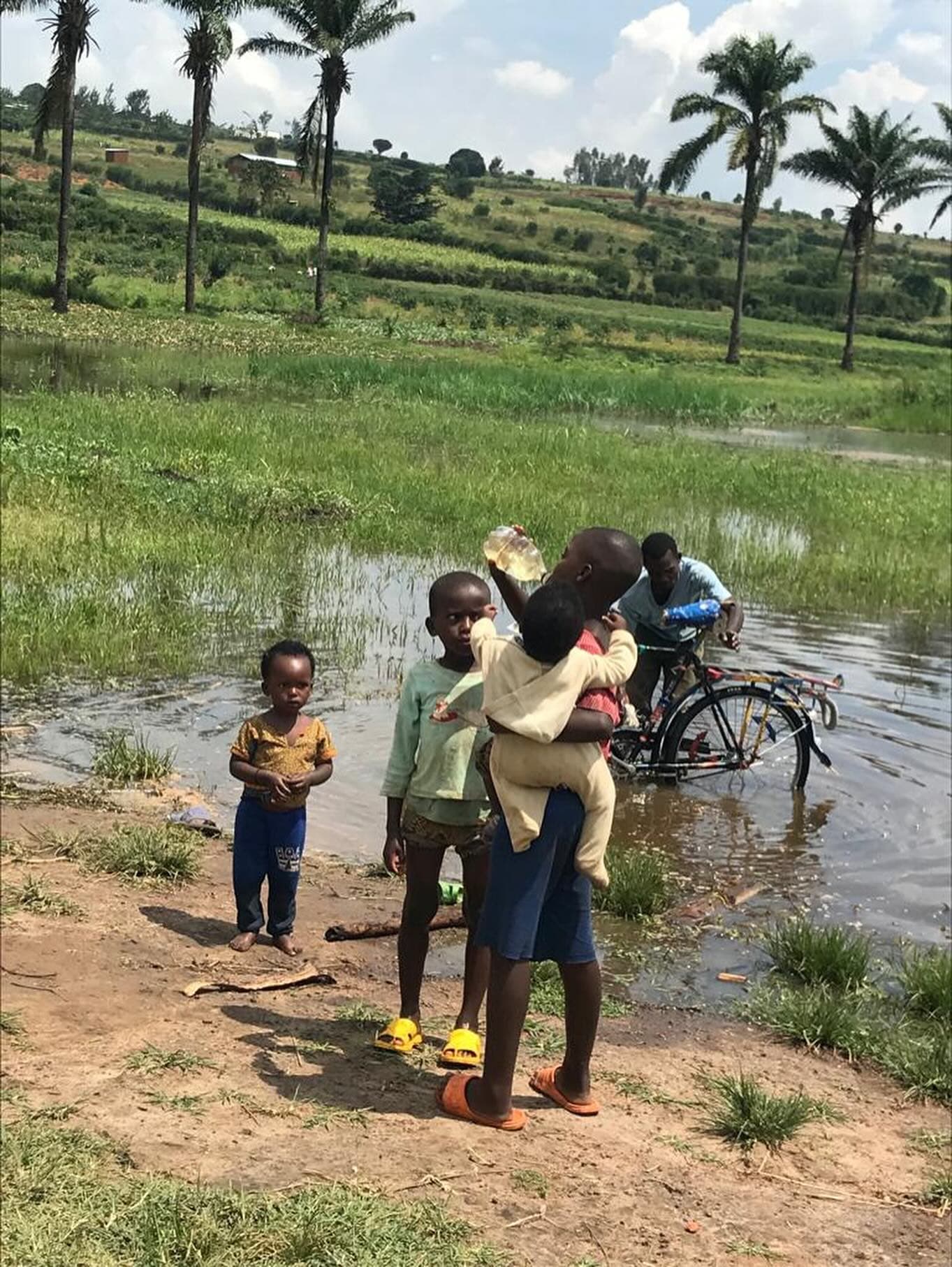
Photo by Nadine Uwizeyimana
Gashora, Bugesera · 2026 pilot
Living beside a lake you can't drink from.
SAquaSolve Rwanda is changing that.
Water for all. Peace for all.
SAquaSolve Rwanda is working with communities in Gashora, Bugesera, to explore safe, locally appropriate drinking-water solutions. Our 2026 pilot begins with field validation, community engagement, water assessment, and practical education.
The reality in Bugesera
9 lakes
Bugesera is home to nine lakes and three rivers, including Lake Mirayi in Gashora Sector. Water is present; safe, dependable service is the harder question.
20.9%
of Bugesera households report not using the drinking-water source they identify as nearest. Among that subgroup, 65.7% cite that it does not function properly.
Aug 2026
The Gashora pilot's engineering phase measures Lake Mirayi's water quality and establishes the treatment requirements, siting, and operating plan for the kiosk.
The model
The Gashora pilot
A lake is not automatically a drinking-water system.
Lake Mirayi is the intended candidate source for the Gashora pilot. The pilot engineering phase will establish the exact treatment requirements, equipment sizing, siting, operating procedures, and regulatory safeguards for responsible construction.
Confirm the Lake Mirayi source
Lake Mirayi is the intended source for the Gashora kiosk. Source testing establishes its water-quality conditions, siting, regulatory fit, and lifecycle cost ahead of construction.
Match treatment to measured water quality
Treatment and disinfection are designed to the raw-water quality that testing reveals, rather than a fixed recipe chosen in advance.
Solar power where it earns its place
Solar energy is used where it is technically and economically appropriate, improving reliability or lifecycle cost rather than serving as a headline.
Protect storage and distribution
Treated water is kept safe in protected storage and delivered through a controlled, dignified access point for the community.
Verify water quality continuously
Routine testing, records, and independent monitoring keep the service verifiably safe over time, not just on day one.
Local operations, affordability and accountability
Trained local operators run daily service, maintenance, and community education, within an operating model designed to be affordable and accountable.
Why this project exists
“When water exists near a community, I believe it should become an asset that strengthens local health, dignity, and opportunity.”
Sonia Irakoze came to Gashora as a boarding student at GGAST and spent three formative years there. SAquaSolve returns to that community with an engineer's discipline: measuring the source and engineering the kiosk with residents and technical partners, defining how it will be built responsibly.
Sonia Irakoze, Founder & Project Lead
The plan
The 2026 Gashora pilot
Engineer it right. Then build it.
We are building toward a working kiosk in Gashora. The pilot engineering phase establishes the exact treatment requirements, equipment sizing, and siting, so construction is done responsibly.
Now · August 2026
Community & engineering phase
Community engagement in Gashora, laboratory testing of the Lake Mirayi source, site assessment and hydraulic work, pilot system design, approval coordination, and implementation preparation. This phase establishes the treatment requirements, equipment sizing, and siting for the kiosk.
Next · Following the engineering phase
Kiosk construction & commissioning
Following the pilot capital round, regulatory approvals, and final engineering, SAquaSolve will procure equipment, construct and commission the solar-powered kiosk, train local operators, and launch performance monitoring.
The project sequence
- Pilot preparation & community partnership
- Source testing & site-specific engineering
- Regulatory & implementation planning
- Kiosk construction, commissioning & operator training
- Performance monitoring & responsible expansion
The 2026 Gashora pilot is in stage one: pilot preparation, community partnership, and source testing.
Where things stand
Verified starting points.
9
lakes identified by Bugesera District, including Lake Mirayi in Gashora Sector (not all are drinking-water sources)
2026
Davis Projects for Peace grant supporting the Gashora community and engineering phase
Aug 2026
the Gashora pilot's engineering phase: workshops, baseline testing, mapping, and listening
GGAST
confirmed workshop partner for the 2026 phase
Funded through

Get involved
Advance the 2026 Gashora pilot.
Partner with SAquaSolve on water testing, engineering, GIS, institutional coordination, or funding, or support the pilot directly.